
How Rising Costs Are Reshaping School Menus — And What Directors Must Do Now
School nutrition programs are buying food in the same economy as everyone else. Not only is food getting more expensive, so are labor, supplies, utilities, and other operating costs. USDA meal reimbursements have not kept up with this inflation.
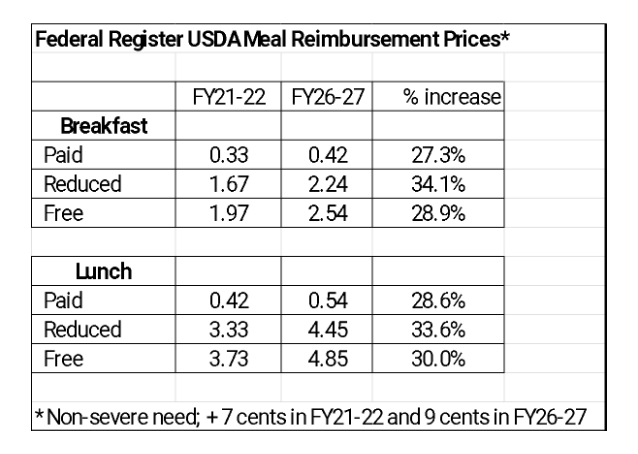
Here's the basic financial challenge:
The recommended food cost for a school meal is roughly 40% of the federal reimbursement. For lunch, that is $1.94. The remaining money has to cover everything else.
A single food item can consume a surprisingly large portion of the food budget:
Pizza slice: approximately $0.85
Chicken leg: approximately $1.02
2-ounce hamburger patty: approximately $0.97
And those are just the entrée items. Add milk, fruit, vegetables and a whole-grain component, and suddenly that $1.94 lunch food-cost target becomes extremely difficult to hit. The math simply doesn't work the way it used to. The chart below provides a few comparisons.
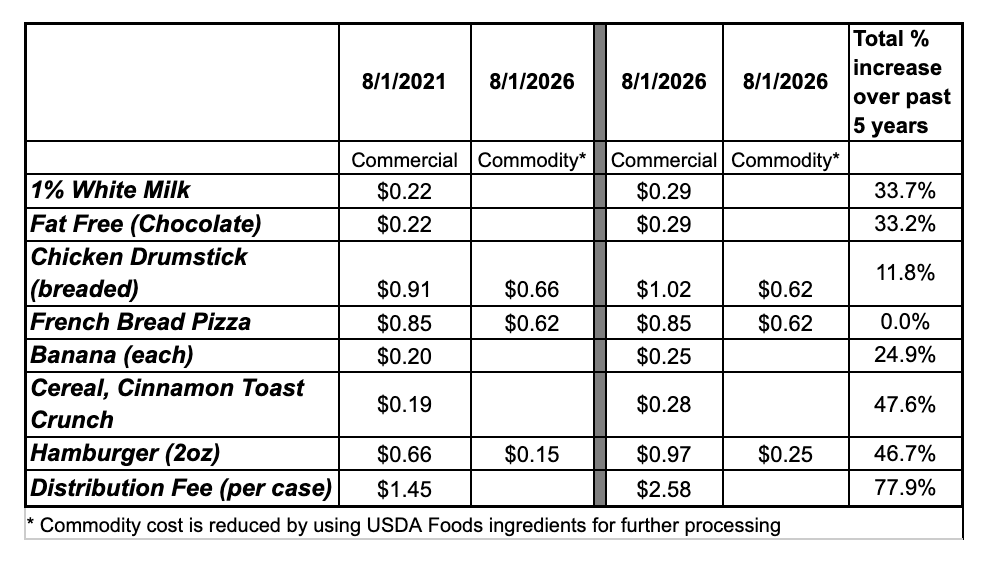
The numbers tell an important story: Some foods have increased in price modestly. Others have increased in price dramatically. Distribution costs have increased even more.
This means school nutrition directors can't assume that a menu that worked financially a few years ago, or even last year, will still work today.
KNOW THE DIFFERENCE: PLANNED FOOD COST VS. ACTUAL FOOD COST
One of the most important financial conversations school nutrition leaders should be having is the difference between the cost of planned menus and the cost of the meal students are actually served. These numbers are not the same.
USDA meal requirements mean schools can't simply build a menu around whatever happens to be cheapest. Meal requirements mean offering students all required components.
Under the Offer versus Serve (OVS) rules, students have some flexibility in what they select. For example, at breakfast, students must be offered the required fruit serving but they don't necessarily have to take the entire amount offered for the meal to be reimbursable.
That flexibility is important — not just for students, but for school foodservice budgets.
Planned Meal Cost: The Upper Limit
The planned meal cost assumes that all meal components are prepared and served to the projected number of students. It provides a conservative baseline for budgeting.
Served Meal Cost: What Actually Happened
If students don't select every component they are offered, the actual amount of food used may be lower than the original forecast.
The Variance Gap
The variance gap is the difference between planned and actual food costs.
That gap can represent:
Savings from lower actual usage
Unused inventory
Overproduction
Plate waste
Incorrect forecasting
Opportunities to improve menu planning
The important point is this: You can't manage what you don't measure.
A SIMPLE EXAMPLE
Imagine a school that plans to serve 215 meals. The original plan assumes every student will receive every item offered. Because of student choices and OVS, actual usage is lower.
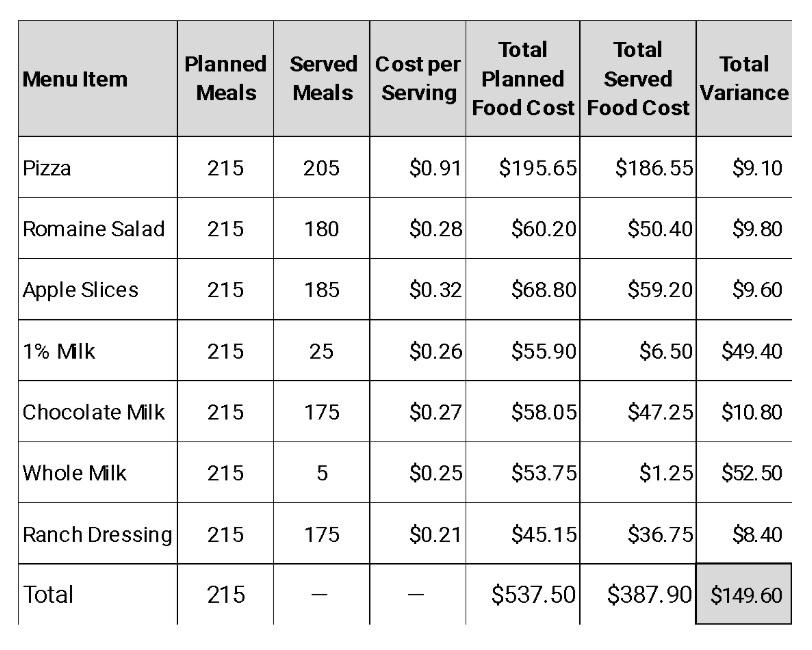
Variance: $149.60 less for the food cost as served compared to planned.
That's a significant difference.
But here's the important part: a lower served cost isn't automatically a savings.
If the difference is caused by students declining food that was already prepared, the district may have simply moved the cost from the serving line to food waste.
If, however, the district is accurately forecasting production, managing portions and using OVS effectively, that difference can represent a real opportunity to control food costs. That's why production records matter.
What Can School Nutrition Directors Do Right Now?
This isn't the year to set the menu and forget it. Here are five things worth doing now:
Know Where Your Costs Are Increasing
Identify which food categories have increased the most compared with last year.
If a product has increased by more than 5%, ask whether there is another product, recipe or menu option that could accomplish the same goal for less.
Cost Out Your Menus Frequently
Build process for reviewing menu costs regularly and adjusting when necessary.
Consider shifting high cost menu items to low participation days and low cost menu items to high participation days.
Watch Actual Production Costs
Compare your planned food cost with your actual food cost.
Your production records can tell you a story that your budget report can't.
Protect the Foods That Matter
A lower-cost menu isn't necessarily a better menu and can impact participation!
When budgets get tight, it's tempting to cut anything that costs more.
Communicate the Financial Reality
School nutrition directors should be sharing these numbers with supervisors, business managers, superintendents and school boards.
Make the financial story visible. Document the increase in your products and distribution costs and how it impacts your menus.
Identify how lower cost/less popular items impact participation and food waste.
The Bottom Line
2026–2027 is going to require school nutrition professionals to be part nutritionist, part chef, part purchasing expert, part data analyst and part financial manager.
Families are struggling with higher food costs. Federal nutrition programs are changing. School meal requirements remain demanding. Food prices continue to put pressure on already-tight school nutrition budgets.
But this is also an opportunity to get smarter about how school meals are planned, purchased, prepared and served. It's also the time to revisit your commodity entitlement and make sure you are using every entitlement dollar to its fullest potential.
Our job is to ensure students have access to a nutritious meal when they need it most. In 2026–2027, that may matter more than ever.
ABOUT THE AUTHORS

Lora spent nearly 20 years as the Senior Director for the Orange County Public Schools (OCPS) Food and Nutrition Program in Orlando, Florida. During her tenure, she tripled the meals served to one million every five days. During the pandemic, OCPS served 46 million meals, an increase of 28% from the 2019 school year.
Lora's extensive accomplishments at OCPS inform her current work with ProTeam where she is passionate about helping to empower nutrition professionals to improve access to school meals.
Kymm Mutch, Mutch Better Foods, LLC.

Kymm is Owner and Principal of Mutch Better Foods, LLC. where she works with an array of clients to develop products for school food markets.
She spent nearly a decade administering Milwaukee Public Schools’ federally funded meal program including budget development, fiscal management, and meal counting and claiming accountability. She has managed procurement for MPS with a $42 million budget, as well as for three regional co-ops in Kentucky, Michigan, and Wisconsin.