
Five Things District School Foodservice Teams Should Be Doing Over the Summer
For school foodservice teams, summer break is less “vacation mode” and more “reset and prep season.” While students are off enjoying summer, district teams have a huge opportunity to regroup, refresh systems, and set the tone for a smoother school year ahead.
1. Get Back-to-School Training on the Calendar ASAP
If August always feels chaotic, the fix starts now.
Set your back-to-school training date early and build a realistic timeline for trainers to:
Develop overall outline
Assign trainers and topics
Submit first drafts
Receive feedback
Finalize materials
Practice presentations with teammates before the full staff training
Think of it like a soft launch before the big launch. Ask the trainers for the evaluation questions they will ask staff after the training. What is it they want their staff to learn? This leads to improved training and techniques to enhance learning.
This process for developing the training allows time to identify what skills need to be refined and practiced. Last-minute development is avoided using this timeline and connections with other trainers ensures the staff are all going in the same direction. As the training is developed, look at the following:
Content accuracy
Reader-friendly language
Demonstrations, group activities, hands-on education as well as listening
Training flow
How staff understanding will actually be measured afterward
And honestly? Peer presentations are underrated. When trainers present to coworkers ahead of time, it creates consistency across the district and gives everyone a chance to offer feedback before school starts. Fewer surprises in August = better energy for everyone.
2. Do a Real End-of-Year Review — Not Just a Quick Recap
Before diving into next year’s plans, take time to objectively evaluate the school year you just survived.
Aim to publish and review year-end results by July 1. Financials may still be preliminary, but participation numbers plus food and labor costs should be finalized.
Then schedule a leadership meeting with district foodservice staff and make it collaborative — not just another meeting where one person talks the whole time.
Block off at least 3–4 hours for a SWOT analysis:
Strengths
Weaknesses
Opportunities
Threats
Or keep it simple with posters labeled:
“Stop Doing”
“Keep Doing”
“Needs Improvement”
Hand out sticky notes and let staff share honest feedback. After about 10 minutes, group similar comments together to identify the biggest trends.
This part matters: discuss the themes openly with your team.
People want to feel heard — especially the staff members working directly with students every day. The best ideas often come from the people closest to the work.
Reminder: Nobody runs a successful school nutrition program alone. Strong teams build strong programs. Buy-in is a powerful multiplier.
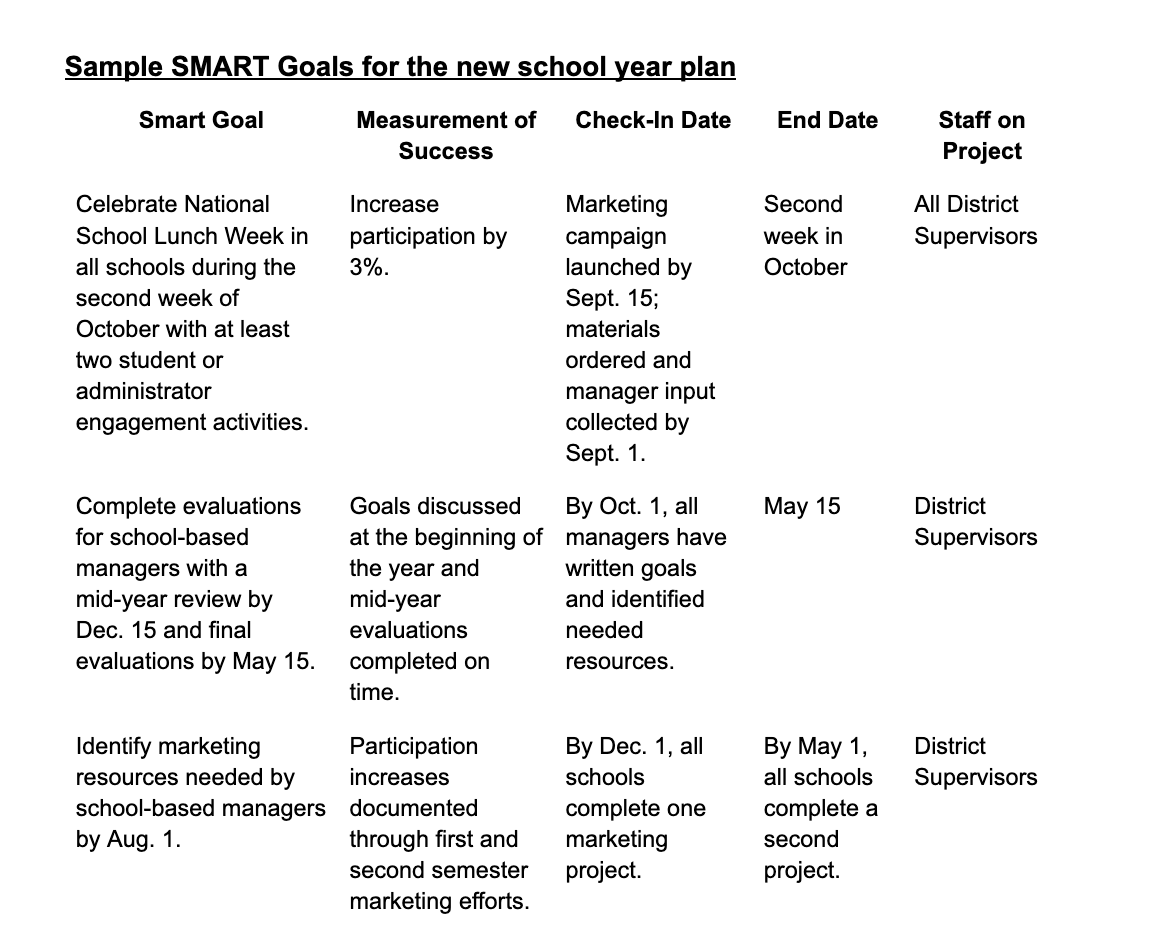
3. Set SMART Goals That Actually Mean Something
Now that you’ve reviewed the past year, it’s time to build goals for the next one — and not the vague kind that get forgotten by October.
SMART goals work because they create clarity and accountability.
SMART GOALS SHOULD BE:
Specific — Clearly identify what you want to improve.
Measurable — Decide how success will be tracked.
Achievable — Set goals that challenge staff without overwhelming them.
Relevant — Make sure the goal actually supports students, staff, or operations.
Time-Bound — Include deadlines and check-in dates to keep momentum going
Example: Improve Communication with School Administrators
Instead of saying “communicate more,” identify real opportunities for connection:
Administrator trainings (ask to cater a breakfast and then ask if you can speak for a few minutes)
School-site meetings
District events
Catered staff gatherings
Many districts already hold back-to-school administrator trainings that include meals. That’s a perfect opportunity for the foodservice department to:
Cater the event
Introduce program priorities
Explain regulation updates
Clarify meal requirements
Share why students need to select a fruit or vegetable but don’t have to take milk
You can also send a back-to-school email outlining:
Department goals
Special menus
Thanksgiving meal dates
Upcoming promotions
Annual events
Setting the tone early helps build stronger relationships all year long.
4. Recalculate Menu Costs Before Prices Surprise You
Even when next year’s menus are technically finished, summer pricing changes can throw everything off fast.
Before the school year starts:
Recheck vendor pricing
Update food costs
Adjust projected menu expenses
Build in a small cushion for inflation or product increases
Using realistic numbers now helps avoid budget stress later. Nobody enjoys scrambling to fix menu costs halfway through the semester.
5. Invest in Yourself, Too
Leadership in school nutrition can feel isolating sometimes.
Directors, supervisors, and district managers often carry a lot of responsibility while also trying to support everyone else. Summer is a great time to pause and think about your own growth.
Ask yourself:
What skills do I want to strengthen?
Where do I need more confidence?
Who could mentor me?
What systems or leadership strategies could I learn from another district?
Professional development doesn’t have to mean completely overhauling your career. Sometimes growth looks like:
Attending a conference
Taking a leadership course
Learning more about communication or business management
Visiting another district
Building a stronger professional network
The better you lead yourself, the stronger your team becomes too. Any of the above or simply reading a leadership book helps you build the knowledge, language, and skills used by other successful leaders. Improving your own performance will also strengthen the people you lead and supervise.
And in school foodservice, strong leadership impacts everything — from team culture to student experience.
Suggested Reading
Getting to Yes, by Roger Fisher and William Ury
Showing our True Colors, by Mary Miscisin
Leading Change, by John P. Kotter
Strengths Based Leadership, Gallup
7 Habits for Highly Effective Managers, Steven Covey
S.M.A.R.T. Goals Made Simple, by S.J. Scott
ABOUT THE AUTHORS

Lora spent nearly 20 years as the Senior Director for the Orange County Public Schools (OCPS) Food and Nutrition Program in Orlando, Florida. During her tenure, she tripled the meals served to one million every five days. During the pandemic, OCPS served 46 million meals, an increase of 28% from the 2019 school year.
Lora's extensive accomplishments at OCPS inform her current work with ProTeam where she is passionate about helping to empower nutrition professionals to improve access to school meals.
Kymm Mutch, Mutch Better Foods, LLC.

Kymm is Owner and Principal of Mutch Better Foods, LLC. where she works with an array of clients to develop products for school food markets.
She spent nearly a decade administering Milwaukee Public Schools’ federally funded meal program including budget development, fiscal management, and meal counting and claiming accountability. She has managed procurement for MPS with a $42 million budget, as well as for three regional co-ops in Kentucky, Michigan, and Wisconsin.