USDA Milk Rule Changes
If you haven’t heard yet, a new USDA final rule set to take effect on June 8, 2026, is giving schools and child care providers a lot more flexibility when it comes to what ends up in that milk carton on students' trays. For some operators, this is welcome news. For others, it raises questions worth thinking through carefully before making any changes.
What changed and why
For years, most children ages 2 and up could only be served low-fat (1%) or fat-free milk in federally reimbursable meals. Whole and reduced-fat milk simply weren't on the table.
Now, that’s changing. Here's a quick breakdown of the upcoming changes by age group:
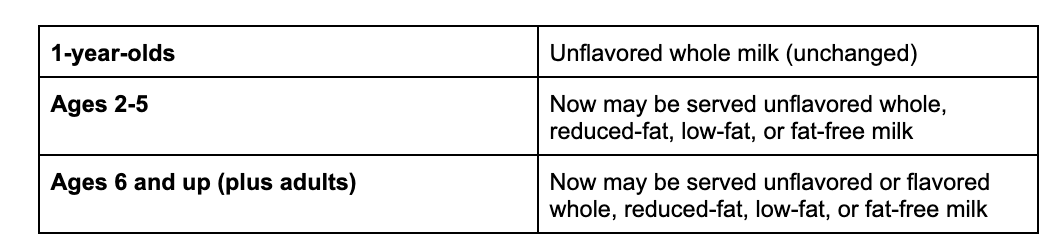
This applies across the National School Lunch Program (NSLP), School Breakfast Program (SBP), NSLP Afterschool Snacks, the preschool meal pattern for NSLP and SBP, Smart Snacks in Schools, Child and Adult Care Food Program (CACFP), and the Special Milk Program.
The 2025–2030 Dietary Guidelines for Americans gave full-fat dairy a rehabilitation, noting that dairy is an excellent source of protein, healthy fats, vitamins, and minerals, and that full-fat dairy specifically supports energy needs and brain development in children. The new rule aligns school nutrition policy with that science.
Why consider adding reduced-fat and/or whole milk?
Before deciding whether to implement reduced-fat and/or whole milk options, operators may want to weigh several potential benefits alongside practical operational considerations.
It tastes the same as it does at home. The reality is that children are more likely to drink milk that tastes familiar. 72.3% of total milk sales at grocery stores are either whole or reduced-fat milk (USDA AMS). If school milk tastes like the milk in their refrigerator at home, then there may be more hands in the cafeteria milk box.
It has all the same essential nutrients. Whole and reduced-fat milk provide the same nutrients as low-fat and fat-free milk options including protein, calcium, potassium, phosphorus, riboflavin, niacin, and vitamins A, D, and B12. If milk consumption goes up, so does nutrient consumption, and that matters for growing bodies and minds.
Milk offerings may align more easily across age groups. Fewer SKUs, fewer headaches, fewer compliance slip-ups. For districts that serve both preschool-aged children and younger children in childcare settings, offering whole milk could create opportunities for greater menu consistency across programs. If pre-K students are able to receive the same milk type as 1-year-olds, operators may benefit from simplified ordering, storage, production planning, and staff training by reducing the number of milk varieties managed across sites. That's a practical win for any nutrition director juggling a hundred other things.
Saturated fat is not counted. As a bonus, schools in the NSLP and SBP can now exclude the saturated fat from fluid cow’s milk when calculating the weekly average saturated fat requirement - making menu planning a little less of a math headache.
Considerations before making the switch
While there are several potential benefits to expanding milk offerings, operators should also carefully evaluate the potential tradeoffs before deciding whether implementation makes sense for their program.
The heart health debate isn’t fully settled. Many professional organizations, such as the American Heart Association and the Academy of Nutrition and Dietetics, continue to encourage low-fat and fat-free dairy products as part of heart-healthy dietary patterns.
Student behavior may not change as expected. Whether offering whole milk in school will meaningfully increase milk consumption over juice or other beverages remains to be observed and tracked. The assumption that whole milk will automatically be embraced over other options isn't guaranteed.
Cost and procurement adjustments may be needed. Adding a new milk variety means renegotiating with vendors, updating purchase orders, and potentially managing more SKUs in the short term — even if the long-term goal is simplification. For smaller districts with tight budgets or limited storage, the transition could require some upfront investment of time and resources.
Calories still count. Unflavored whole milk has 150 calories per 8 fluid ounces, and flavored whole milk could have about 200 calories per 8 fluid ounces, depending on brand. That’s a 70-120 calorie difference compared to 8 fluid ounces of unflavored skim milk. While saturated-fat is excluded from the nutrient analysis, the additional calories coming from milk fat are still counted. These additional calories are a heavy hitter when offered daily.
The good news is that this rule expands options, it doesn’t mandate requirements. Operators who are happy with their current milk choices can stay the course. Those who have been waiting for this flexibility now have it. The decision belongs to the people who know their students and communities best.
This is a "final rule with comment period," which means it's in effect but the USDA is still accepting public comments through June 8, 2026. Comments may be submitted in writing at Regulations.gov or by mail to the School Meals Policy Division in Alexandria, VA. Comments will help the USDA weigh stakeholder input when considering future guidance or rulemaking on the expansion of fluid milk options.
Read the final rule here.
References:
Anthropic. Claude AI (Claude Sonnet 4.6). Article drafting assistance. May 2026. https://www.claude.ai
U.S. Department of Agriculture, Agricultural Marketing Service. Estimated Fluid Milk Products Sales Report. May 14, 2026. https://www.ams.usda.gov/mnreports/ams_3358.pdf
U.S. Department of Agriculture, Food and Nutrition Service. Expanding Fluid Milk Options in Child Nutrition Programs (Final Rule). May 8, 2026. https://www.fns.usda.gov/cn/fr-050826
U.S. Departments of Agriculture and Health and Human Services. Dietary Guidelines for Americans, 2025–2030. January 7, 2026. https://cdn.realfood.gov/DGA_508.pdf
Whole Milk for Healthy Kids Act of 2025, P.L. 119-69. Signed January 14, 2026. https://www.congress.gov/119/plaws/publ69/PLAW-119publ69.pdf
International Dairy Foods Association (IDFA). IDFA Celebrates Final Passage of Whole Milk for Healthy Kids Act. December 15, 2025. https://www.idfa.org/news/idfa-celebrates-final-passage-of-whole-milk-for-healthy-kids-act
International Dairy Foods Association. School Milk Is Critical to Child Nutrition: School Year 2025–2026 Fact Sheet. https://www.idfa.org/wordpress/wp-content/uploads/2025/08/Back-to-School-Fact-Sheet-2025-2026-1.pdf
National CACFP Association. Final Rule: Expanding Fluid Milk Options in CNPs. May 8, 2026. https://www.cacfp.org/2026/05/08/final-rule-expanding-fluid-milk-options-in-cnps/
CNN. Whole milk now allowed in school lunches as Trump signs bill reversing limits. January 15, 2026. https://www.cnn.com/2026/01/14/health/whole-milk-healthy-kids-act
National Milk Producers Federation. USDA Clears Path for Whole Milk in Schools. May 2026. https://www.nmpf.org/usda-clears-path-for-whole-milk-in-schools/
ABOUT THE AUTHOR

Colette is a Registered Dietitian with nearly 20 years of foodservice experience, including more than a decade of experience dedicated to child nutrition.
Colette collaborates with districts to produce and maintain cost-effective, complaint menus and assists districts with administrative review preparation. She also develops digital tools for existing and potential clients.
Before joining ProTeam, Colette was a multi-state Resident Dietitian for Chartwells K-12.